
What was the first ever search engine is a question most people get wrong. The answer is Archie, a tool built in 1990 to index file archives, not websites, because the web didn’t exist yet. Alan Emtage, a student systems administrator at McGill University in Montreal, wrote it to solve a genuinely annoying daily problem: nobody knew which FTP servers held which files. He released it in September 1990, which is eight years before Google registered its domain.
And the reason this matters is that it shifts the whole story. Search didn’t start with blue links and keyword ads. It started with a script scraping file names off anonymous FTP servers every night, letting you query them by name pattern. Clunky by any modern measure, but people used it constantly across university networks.
Understanding the lineage from Archie forward also explains why early web search engines looked the way they did. They inherited assumptions about indexing, query syntax, and update frequency from a generation of tools built for a pre-web internet.
Archie the 1990 File Finder
Emtage named the tool Archie by shortening “archive,” not as a reference to the comic strip (though that connection got played up later). It worked by connecting to roughly 10 FTP sites at launch and downloading directory listings on a monthly cycle. By 1992 it was tracking over 2.5 million files across more than 200 servers, which was a genuinely large index for the time.
Queries were basic. You could search by file name or partial name, case-sensitive or not, and get back a list of matches sorted by host. You’d then manually FTP into the server and grab the file. Slow, yes, but before Archie there was nothing. You either knew where a file lived or you asked someone on a mailing list and waited days.
McGill eventually asked Emtage to move Archie off university servers because the traffic load was significant. By that point other institutions were running mirror copies, which tells you how widely it had spread.
Veronica, Jughead, and Gopher
While Archie indexed FTP directories, a parallel system called Gopher was taking off through 1991 and 1992. It organized information in hierarchical menus rather than hyperlinks and became genuinely popular at universities before the web overtook it. Gopher needed its own search layer, and that’s what Veronica and Jughead provided.
Veronica (Very Easy Rodent-Oriented Net-wide Index to Computerized Archives, a backronym someone clearly labored over) launched in November 1992 from the University of Nevada. It crawled Gopher menus across the network and let you search item titles. Jughead appeared in 1993 and did something slightly different: searching a single Gopher server’s hierarchy rather than the whole network, which made it faster for local queries.
Neither tool survived Gopher’s collapse. Once the web spread and browsers made hyperlinks the default navigation model, Gopher traffic dropped sharply through 1994 and 1995. But Veronica and Jughead matter here because they show that search was being independently invented in parallel, not as one tidy linear progression.
First Web Search Engines, 1993–1994
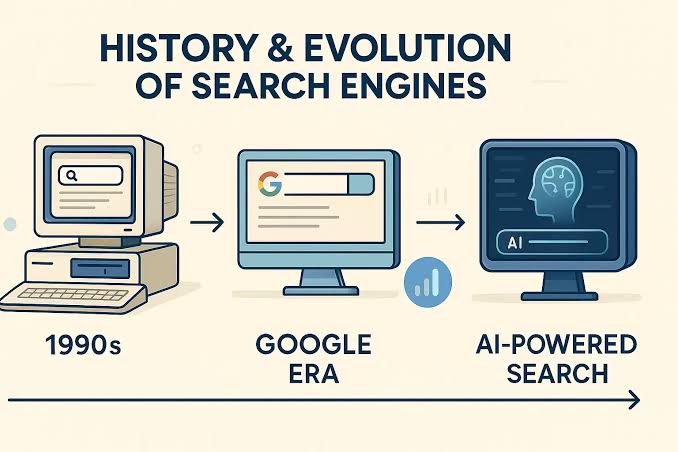
The World Wide Web launched publicly in 1991, but the first search engine built specifically for it didn’t appear until October 1993. That was ALIWEB, created by Martijn Koster. It didn’t crawl automatically; site owners submitted an index file describing their pages, which ALIWEB aggregated. Coverage was thin, but the idea of searching web pages specifically was new.
WebCrawler changed the model. Launched in April 1994 by Brian Pinkerton at the University of Washington, it was the first tool to actually crawl web pages and index their full text, not just titles or submitted descriptions. By the end of 1994 it had indexed around 75,000 pages, which sounds tiny now but represented most of the publicly accessible web at the time.
Lycos followed in July 1994 and was indexing millions of pages by early 1995. AltaVista launched in December 1995, handling natural-language queries and returning results in under a second on hardware that cost Digital Equipment Corporation a serious amount of money to run. Yahoo launched its directory in 1994 too, though it was human-curated rather than crawled, which is a meaningful distinction.
| Tool | Launch | What it indexed |
|---|---|---|
| Archie | Sept 1990 | FTP file names |
| Veronica | Nov 1992 | Gopher menu items |
| ALIWEB | Oct 1993 | Submitted web pages |
| WebCrawler | Apr 1994 | Full web page text |
| AltaVista | Dec 1995 | Full web, fast retrieval |
| Sept 1998 | Web, ranked by links |
From Archie to Google
What was the first ever search engine is really just the opening question in a story that compressed fast. Eight years separated Archie in 1990 from Google’s founding in September 1998 by Larry Page and Sergey Brin at Stanford. In that span, indexing shifted from file names to full text, ranking shifted from alphabetical lists to link-based authority scoring, and the user base shifted from a few thousand university researchers to tens of millions of ordinary people.
Google’s PageRank algorithm was the real break from the prior generation. AltaVista and Lycos ranked by keyword frequency and placement. PageRank treated incoming links as votes, producing noticeably better results for ambiguous queries. Within about two years of launch Google had become the default for most English-language search, and AltaVista, which had seemed untouchable in 1997, was essentially irrelevant by 2002.
The honest caveat here is that “first” in tech history is usually messier than one name and date. There were internal tools at CERN and elsewhere that searched document collections before Archie. But Archie was the first publicly available, network-wide search system, which is the definition most internet historians settle on. Emtage himself has said in interviews that he didn’t think of it as a search engine at the time. He thought of it as a useful script.
FAQs
Was Archie the first search engine ever?
Yes, by the most widely accepted definition. Alan Emtage released Archie at McGill University in September 1990 to index FTP file directories, making it the first publicly available network-wide search tool.
What came before Google as a search engine?
WebCrawler, Lycos, AltaVista, and Yahoo Directory all preceded Google, which launched in September 1998. AltaVista was the dominant full-text search engine through the mid-to-late 1990s.
When did web search engines start?
ALIWEB launched in October 1993 as the first web-specific search engine, followed by WebCrawler in April 1994 as the first to index full page text automatically.